iYappy
Languages are meant to be used.
Learn languages with iYappy
iYappy is building a multilingual way to learn by actually using languages. Every publicly offered course must earn its place through source-qualified material and usable practice.
Courses available now
- Lakȟótiyapi / Lakota — Six source-backed singular forms, with recognition and typed recall. Source: LDL 121, Standing Rock Sioux Tribal Department of Education
Available today: Search 4101 English/Lakota recorded pairs, choose a phrase, and read its translation and source references. Switch the corpus interface between English and Lakota. Practice six written verb forms and explore your recordings in the listening lab.
The Lakota corpus interface labels are machine-translated. Phrase translations come directly from the supplied parallel corpus, with their original source references.
Lakota: six sourced forms
Listening lab: hear rhythm, prominence, and phrasing
Hear a recording you have permission to study, or record yourself. Mark the pulse you feel, prominent moments, and phrase boundaries. These are your observations, not scored Lakota pronunciation or judgments about a recording's meaning. Speech need not follow a fixed beat.
Recordings and marks stay on this device for this session; this lab sends neither to the site and saves neither to learner progress.
Choose a recording, or allow the microphone when you explicitly choose to record.
A — · B —
Listen first. Mark only what you hear; no control automatically identifies pitch, syllables, stress, or correct speech. Consult a knowledgeable speaker for pronunciation and interpretation.
English–Lakota corpus
Find a phrase, choose it, and read its recorded translation. (4101 Corpus pairs)
Matching phrases
Corpus lookup uses recorded translations. It does not call a language model.
Use the Lakota–English corpus
Recorded translation pairs from the supplied parallel corpus. These files preserve original text and source references; no inference was used to generate translations.
Pair count: 4101
Corpus encodings: Apache-2.0 license. Original source references remain in each record.
SVG language lab
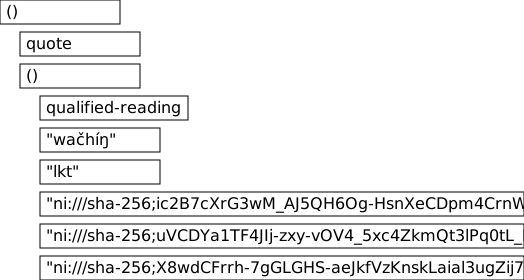
Render a phrase or program as a diagram, export its SVG, and read the same image back into text.
Actual surface: wačhíŋ
Source: Supplied Lakota corpus: data/corpus.jsonl, line 1
- lakota-operational-reading.json
- lakota-operational-reading.nq
- lakota-operational-reading.svg
- lakota-operational-sparql.json
Loading course…
Lesson sources and listening research
These six singular forms follow the charts in LDL 121: Intensive Lakota/Dakota for Beginners, prepared by the Standing Rock Sioux Tribal Department of Education's Lakota/Dakota Language Revitalization Program.
See yuhá, PDF page 20 and čhíŋ, PDF page 46. This practice covers these forms; it does not assess pronunciation or teach a general conjugation rule.
Listening research
Speech and music both involve timing, grouping, and expectation, without interchangeable structures. Lakota has studied lexical stress, pitch accents and phrase boundaries. The listening lab helps you explore your own observations of legally obtained or personally recorded audio, without judging pronunciation.
Research: Mirzayan, Lakota Intonation and Prosody (2010); Patel and Daniele, speech–music rhythm (2003); Drakoulaki et al., language–music review (2024).
Read and practice here
You can use this section with JavaScript disabled, or save the page. Open the answers before printing. First recall the form for each person, then open its answer. Next cover the person labels and identify the person from each form.
Download sourced language data · Download reading-memory data
yuhá (have something): 1st person singular
bluhá
yuhá (have something): 2nd person singular
luhá
yuhá (have something): 3rd person singular
yuhá
čhíŋ (want something): 1st person singular
wačhíŋ
čhíŋ (want something): 2nd person singular
yačhíŋ
čhíŋ (want something): 3rd person singular
čhíŋ